Sunday, October 31, 2010

Icarus


LANDSCAPE WITH THE FALL OF ICARUS


by William Carlos Williams, According to Brueghel

when Icarus fell
it was spring
a farmer was ploughing
his field

the whole pageantry
of the year was
awake tingling
near

the edge of the sea
concerned
with itself

sweating in the sun
that melted
the wings' wax
unsignificantly

off the coast
there was
a splash quite unnoticed
it was
Icarus drowning.


Icarus is found on some stamps, I show a few here (click on the picture and you may see it in a bigger format). The stamp above representing the painting of Breugel somewhat misses the point: you see the farmer, but Icarus drowning is in the left corner of the painting, it fell off the stamp.


These above are 1924 Hungarian air mail stamps.


The Chagal representation is fundamentally different then the Breugel: here people look what happens and they witness the drama of the free fall, whereas Breugel shows that the world goes on, nobody is watching or perhaps even caring for the fallen man. 


Sunday, October 3, 2010

1937 1d Scarlet cancelled booklet pane

Contrary to what I thought initially, since my last post, I have not come across many stamps that were cancelled in a similar brutal way as the deposited Iranian leader.

However, this 1937 1d Scarlet booklet pane of 6 overprinted (cancelled type 33P) comes near.


Can't help finding there is something sad about them.

Wednesday, August 25, 2010

Iran 1925 interesting overprinted set Shah Ahmed


This is an interesting example with what can happen if a ruler is replaced: in 1925 Sultan Ahmed was deposed, and pending the issue of new stamps the new ruler of Persia, Riza Khan Pahlevi, ordered that the portrait of the deposed Shah should be obliterated on all stamps by any convenient method. Lewis (in his book as cited in an earlier post) writes: 

"The degree of obliteration rather naturally varied with the sympathies of, or means available to, the person doing the obliterating. Thus we can find square or circular cork (?) impressions, thumb or finger prints, pen or pencil scratches or doodles, and so on; either thinly or thickly applied."  

An association I had when seeing these stamps was with a French stamp I have of Maréchal Pétain, after the 2nd world war his image was not to be seen any more, a liberated country wanted to de-face the leader of the oppressors. Well, no shortage of corks in France!  


My guess is there are many more examples of rulers on stamps that have been obliterated in a heavy fashion when the times - and their luck - were changing. I will be on the look out for them. If you know of any, let me know! I may add them to this post.     

Monday, August 16, 2010

Adventure and Discovery in a Philatelic Jungle

As I wrote in my last post, there is some more information on this airmail set to come. Here it is.
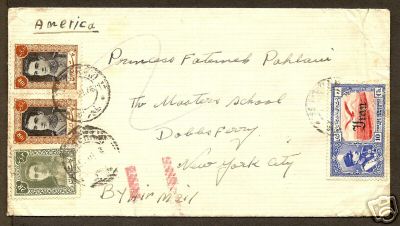
On the deposition of Sultan Ahmed in 1925, stamps with the name of the new ruler Riza Shah Pahlevi were pressed into service and overprinted with his name.

They were followed in 1926 by the first stamps of Riza Shah, the title Riza Shah assumed as a result of his succesful revolt.


In 1930 a handsome air mail set appeared, completing the current definitive issue and using the same portrait of the Shah. The design, as I have said, showed an eagle flying the Elburz Mointans, was in horizontal format printed on white wove paper in photogravure up to the 1 Kran value and above that value recess-printes. All values were line per 12 1/2 X 11 1/2 and printed by J. Enschede and Sons.


All values are known with digital "Specimen" overprint on the lower right of the stamp.

These two fine sets were followed in 1931 by a shorter set to 1 Kran and 27 chahis, litographed in two colors by the Mejlis Press. As in their previous productions there was a great range of shades, and though they improved on earlier productions, they were still far behind the quality of the Dutch firm.
As other stamps, the whole airmail set was overprinted in 1935 with "Iran", although its values were also expresse in chahis, Krans and Tomans.  The last stamps to be issued inscribed in French "Postes Persanes" were a series of nine pictorial stamps commemorating the tenth anniversary of the Shah's accession. All future issues were incribed "Postes Iraniennes" or simply "Iran".

There are minor varieties on the overprint on this airmail set, perhaps the most noticeable being a short last serif on the "n" of "Iran" and a lengthened serif to the "a" joining it to the "n". Forgeries were not seen by Brigadier H.L. Lewis, who wrote a remarkable book entitled "The Stamps of Persia".

My information as laid out above comes from this book. I think it is a rare book in itself, as it dates from the early seventies of the last century and published privately. It lacks illustrations, but the information is there. I believe reprints of this book exist. The Introduction is headed "Adventure and Discovery in a Philatelic Jungle", any collector of Persian stamps will agree this is a suitable heading to start a book on the subject!

Friday, August 13, 2010

Persian airmail set printed by J. Enschede and Sons


I like this one, with the eagle flying over the Elburz Mountains and Riza Shah Pahlevi portrait. 

I have more of these stamps on old enveloppes, who says you cannot start a collection by lack of ideas what to collect!    Later more about these stamps ..


Saturday, August 7, 2010

Navajo stamps


I saw a picture of this Navajo weaving in an antiques auction catalogue (it was called a "Navajo rug").


The Navajo of the Southwestern United States are the second largest Native American tribe of Northern America.

I thought "what a great stamp this rug picture would make". A normal association for a stampcentric mind...

Curiously I googled "navajo stamp" and guess what, there are at least 5 stamps of Navajo weavings!

Not being American and living in France I had no clue about the existence of these stamps.


See the middle stamp on the second row (click on the picture and you will see it bigger): A Navajo weaving by Daisy Taugelchee, from the Denver Art Museum, Denver, Colorado. An explanation says "Weaving is the art form for which the Navajo are best known, and the finely woven textiles from the Two Grey Hills region in New Mexico -- characterized by geometric designs executed in natural shades of hand-spun wool yarns with wide or multiple borders -- are highly esteemed. Daisy Taugelchee (1911-1990), who set unprecedented standards of fine spinning and weaving, made this stellar tapestry in the late 1940s."

Then there is this one, they are really 4. I do not have much of a story here, but is the most impressive representation I saw of Navajo weavings on stamps :


There is also a stamp that I had seen before a lot, featuring Navajo silver.


As I now read somewhere there is a story on this stamp.

In 2004 the USPS issued this 2 cent stamp as the fifth design in the American Design Series. The Navajo Indians began silversmithing in the mid-1800s. The silver and turquoise squash blossom necklace on this stamp is a traditional Navajo motif. This stamp (Scott #3749) is a postage stamp that under ordinary circumstances would have been largely ignored by the vast majority of United States Postal Service customers. However, something happened in early 2006 that raised awareness of the Navajo Jewelry stamp to nearly everyone in the United States who mailed first class letters. On January 8, 2006, the USPS raised the rate for mailing a 1-ounce, first class letter from 37 cents to 39 cents. People with a supply of unused 37-cent stamps immediately descended upon their local post office in search of 2-cent "make-up" stamps that would allow them to use their 37 cent stamps.


And I saw a stamp of a Navajo bear.....


Does anybody know more Navajo (related) stamps? Do post me when you have one as I am getting interested in this now.

Friday, July 9, 2010

1851 Isabella II Spain 6c


Today I am showing you two letters I collected of one of the earliest stamps of Spain.

On October 24, 1849 a royal decree, signed by the Count of San Luis, ordered the creation of adhesive postage stamps to be used as prepayment for delivery of mail in Spain. Only two months later, on January 1, 1850 the first set of five stamps was ready and in use. They all show the portrait of Queen Isabella II. The stamps on the above letters are of 1851 and of a different design then the very first stamps.

Mark the 'Araña', or Spider, cancel often seen on first issues. This cancel was first used in Madrid on February 22, 1850. It was introduced in the rest of the country a few days later. The idea with the design of this cancel was to prevent the Queen from being 'de-faced'. Most often the cancellation ink is black, though red, blue and green are known to have been used early on. In 1851 the officially prescribed colour was black. This cancel was mainly used between 1850 and 1851, meaning only on the first issue. It seems to have been used occasionally in 1869 and 1870.

The 'Araña' cancels could sometimes be removed and the stamps could be reused. The 'Araña' was therefore replaced by a heavier cancel, the 'Parilla', an oval with horizontal lines. When some people managed to remove this cancel it was prescribed to use oily ink.

Isabella II (1830-1904) was queen of Spain from 1833 to 1868. She was Spain's first true constitutional monarch during a period of growing social and political conflicts.


The 1851 stamp is shown also on this "stamp on stamp", on the left.