Friday, April 23, 2010

Upside down


Sometimes things go wrong.


Y&T N° 157 k

TYPE BLANC 1/2 SUR 1 CENTIME ARDOISE SURCHARGE RENVERSEE EN BLOC DE QUATRE


Tres belle paire de type Blanc avec surcharge specimen renversée


SYRIE Blanc N° 46
O.M.F. Syrie 50 CENTIEMES
Surcharge Renversée


Nouvelle-Calédonie: 10c. sur 40c. orange,

BLOC de 4 surch. RENVERSEE (N° 11 a Y &T)

Les surcharges était imprimées par feuilles de 50 et les 25 timbres de panneau de droite avaient tous la surcharge renversée

Thursday, March 25, 2010

Colony Club, 564 Park Avenue NY


This letter is addressed to the Colony Club, 564 Park Avenue. A famous address. I had no clue untill I just googeled the address on this letter cover, the cover I have had some years now.

The city's most exclusive and prestigious private women's social club, the Colony Club was founded in 1903.

This was the earliest club in the city created just for women and its
first facility was erected on Madison Avenue at 29th Street and is now the American Academy of Arts.

In 1923, the Colony's current clubhouse opened at 564 Park Avenue. It was built to be 'the finest club-house in the world.'


Delayed by the war (brass window fixtures had been ordered from France and the chandeliers from Germany), the new Colony clubhouse finally opened in 1923.

Who knows, was this letter on an exclusive order of some French artworks or brass fixtures?

Friday, March 19, 2010

Large Indian Civet


Found this stamp on a letter addressed to me. Quite like it.

Browsing the web I found that the Indian civet produces a substance called 'civet', which is used commercially in perfumes....

Tuesday, March 9, 2010

The Battle of Saint Georges Cay


British Honduras is now called Belize and is situated as follows:


From the early 17th century, the area now known as Belize had a troubled history.

The British Settlement of Belize in the Bay of Honduras was a base for privateers who carried out raids against Spanish vessels transporting gold and silver to Europe.

The coral reefs and sand bars of the coast provided hiding places from which to surprise and attack. By the time piracy was suppressed, toward the end of the 17th century, settlers--mostly British--had moved into the area's interior to develop logwood resources.

These logwood resourses continued to be important for the colony.


The small British settlement became a target for attacks from neighboring Spanish settlements as the rivalry between the Spanish and British intensified.

The first attack took place in 1717 when Spanish and Mayan soldiers entered the area from what is now Guatemala.

In the years that followed, Spain made several raids and incursions into various parts of the settlement.

British warships were commonly dispatched to the area in response. In times of threat, the settlers formed an irregular militia, with the help of slaves and Indians.


Hostilities resumed in 1779, however, when local residents fled from Spanish raiders who had kidnapped a number of settlers. This exodus was short-lived; the limits of the British settlement were defined in the Treaty of Versailles in 1783, and British settlers again returned.

Spain's last attempt to dislodge the settlers by force took place in 1798 when the Spanish fleet from Yucatán launched an attack on the settlement.

Although poorly armed and badly outnumbered, local settlers resisted.

The final skirmish involved a sea battle off Saint Georges Cay in which local forces, supported by the British sloop HM Merlin, forced a final Spanish retreat.

This is a picture of Saint Georges Cay now, looks like a paradise.


The Merlin was a quarterdecked sloop, effectively a miniature frigate. 22 Guns. Much like this picture of a sloop of war:


The victory of the Battle of Saint Georges Cay is celebrated each year on September 10th as a national holiday

After that British control over the settlement gradually increased and in 1862 British Honduras was formally declared a British Colony.

Saturday, February 27, 2010

Sociedad del Timbre stamps


I found this "stamp" in a lot of Spanish stamps. It took me a while to find out is is a Revenue stamp. Albacete is a region in Spain.

I found another one on the internet, this one from Curuna .....

Anyone knows who is the allegorical crowned woman?


Here are even more:

Saturday, February 20, 2010

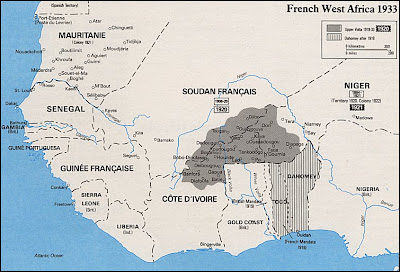
Bobo Dioulasso 4


One letter, front and back both with stamps of the Mosque of Bobo Dioulasso


And here is another one


In Bobo Dioulasso, it is the home of the Bobo's. The population of the Bobo is slightly over 100,000 people. The Bobo have lived in the western region for centuries. Some believe they have been settled in the area since as far back as 800 A.D. These individuals have their own language that we know as simply the "Bobo" language, or "Mande".

The Bobo people are an inherently decentralized group. The various villages that break down their group have their own method of organizing a "political system". They base it on the relationship among individual patrilineages. The idea of placing political power in the hands of an individual is foreign to the Bobo people. The Bobo, like most other cultures, have their own religious beliefs. The creator god of the Bobo is Wuro, who is never physically represented and cannot be described in words according to the Bobo. The god Wuro is the individual responsible for ordering all things in the world into pairs, which must always remain balanced. However, man, through everyday existence is usually responsible for upsetting this balance. The Bobo religious system involves restoring order through a series of offerings.


These are Bobo masks

Sunday, February 14, 2010

Bobo Dioulasso 3

When double clicking on the pictures, you will see them bigger!