Saturday, November 10, 2012

G. Richard and Cie, 5 Rue de la Perle, Paris


Surely this is not a stamp. But it was sitting amongst a lot of "real" stamps I found recently on a fleamarket. I'll bet this is the god Hermes, the god of tradesmen and lyars. His attributes and symbols include the winged sandals, a winged cap and his main symbol was the herald's staff, the Greek kerykeion or the Latin caduceus which consisted of two snakes wrapped around a winged staff.

Made me curious to know what it was, definetely not the Greek stamp you might initially mistake it for.

Imprimatur of the 80 Lepta of the “large Hermes heads” with the inscription of the printer Ernest Meyer. Ernest Meyer was a printer, located at 22, rue Verneuil in Paris during the second half of the 19th century. He had been chosen by to print the first large Hermes head stamps of Greece, the Paris Issue.


G. Richard and Cie. seem to have been printers too.

 
This is a fancy cover of a series of books by Victor Hugo (1802-1885), Œuvres, printed by Richard et Cie between 1885-1895. There are 45 volumes and this fantastic binding was realized by Charles Meunier in 1929.
 
I fond that they have also printed and edited postcards. Was that triggering the printing of the Hermes look-a-like stamp?
 
 
Le Grand Hotel-Cafe de la Paix-Place de l'Opera-Paris, Pre 1920 Postcard of Richard & Cie.  


Monday, October 31, 2011

"Faire sans Dire", le Comte de Reiset


This is a cover of a letter send from Helsingør on 22 january 1865 to Hanover. Helsingør (also known as Elsinore in English) is a city on the northeast coast of the island of Zealand (Danish: Sjælland) in eastern Denmark. Hanover is in North Germany, about 520 kilometer southwest of Helsingør.  

(Stamp Hanover, 1856)


The letter was send to an official of the Franch state: someone with the rank of a minister.

What was the political situation in Hanover 1865? After Napoleon I imposed the Convention of Artlenburg (Convention of the Elbe) in 1803, about 30,000 French soldiers occupied Hanover. The Congress of Vienna in 1815 elevated the electorate to the Kingdom of Hanover. In 1837, the personal union of the United Kingdom and Hanover ended as William IV's heir in the United Kingdom was female (Queen Victoria).


(The House of Hanover - 15 September 2011 - stamps and miniature sheet. The penultimate Kings & Queens issue covers the Hanoverian era from 1714 to 1901).

According to Salic Law Hanover could only be inherited by males.
As a consequence, Hanover passed to William IV's brother, Ernest Augustus, and remained a kingdom until 1866, when it was annexed by Prussia during the Austro-Prussian war.
Gustave Armand Henri, Comte de Reiset, 1821-1905 was a "ministre plénipotentiaire" of Napoleon III of France in Hanover.

(Stamp Napoleon III)
De Reiset was ennobled by King Louis-Philippe and adopted the "devis" : "Faire sans Dire" (do without saying).  He was also member of the Conseil General of the Eure, a region in France. He owned a castle there.


(Photos: French Ministère de la culture - base Mémoire)

 
These are photos of his "Château du Breuil" in Haute-Normandie; Marcilly-sur-Eure (photo around 1900 - 1920).  The Comte de Reiset acquired the Breuil in 1842. The church, at that time, served as a barn. Restored in part, it was destined again to worship in 1854 and then turned into a museum by de Reiset. He filled the museum with objects he reported from his travels. It was possible to admire numerous paintings and ancient statues. De Reiset died in 1905, the church passed to his heirs. The building building was hardly maintained during the second half of the 20th century. Objects of art were scattered and the building fell in despair.
It was classified as an Historical Monument in 1993 and acquired in 1995 by a couple who then started the restoration. It cannot be visited today.  
You can google some artefacts that formerly belonged to Mr. de Reiset, such as this portrait of the famous painter Ingres, this painting is entitled Madame Aymon or  "La Belle Zelie". 


This painting was auctioned in 1870, the same year that Napoleon III lost his war against the Prussians at Sedan and it was the end of his reign.

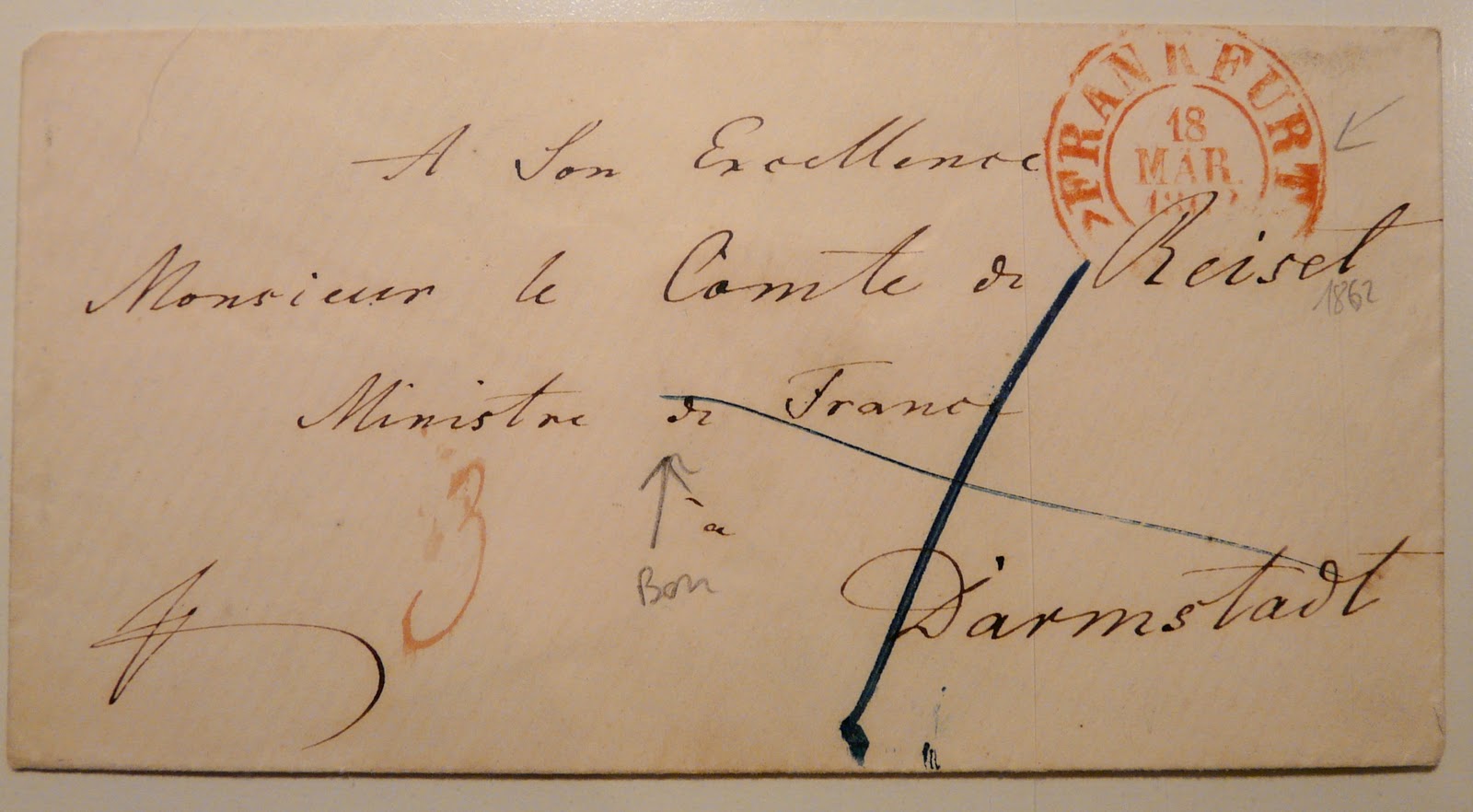
I have a second cover of a letter written to the same Comte de Reiset. It was sent in 1862 from  Frankfurt to Darmstadt.

I do not know about where these covers come from and who took interest to keep them all these years. I bought them in the US, but no story came along with them.


Sunday, October 2, 2011

The role of ladies and girls in the Great War 1914-1918

If you collect stamps, you risk finding other documents, such as old post cards. When I came across this one during a visit to one of the many "brocantes" that are held in the streets in France, I was intrigued by the text as well as the monocle of the officer on the card. An impeccable French officer with a German, bavarian, standard.


It reads "Le Premier Drapeau du Bataillon (I B.VI 132.IVB) d'Infanterie Bavaroise pris par le 10ième chasseur à pied". The standard of the 1st Bavarian Batallion taken by the French. I understand it is a classical card, well known by the collectors.

The text on the card is one of a father, seemingly participating in the war, writing to his young daughter.


In French it reads (lacking interpunction in the original):

"Puisque les classes sont recommencer il faut travailler ;  comme je te le disais dans ma précedente lettre, c'est indispensable. Et jouer il ne faut pas toujours songer à la guerre ni à ses conséquences : c'est l'affaire des hommes les dames et les jeunes filles se doivent les premiers aux enfants et les secondes au travail et de cette façon chacun remplit son devoir dans la nation. Le plus beau drapeau que tu puisse gagner sur ton champs de bataille particulier, c'est ton tableau d'honneur et la place
de première dans toutes les compositions. Je m'arrête ma chère Mignonne en t'embrassent bien fort. Ton père qui t'aime beaucoup" (signature illisible)

I am translating it as follows:

"As classes have resumed you should work : as I said in my previous letter this is indispensable. And play you should not always worry about the war neither about its consequences: it is the business of men and the ladies and the young girls should firstly care about the children and secondly about the work and in this way everybody does his duty for the nation. The most beautiful flag you can win on your own battle field is the table of honnor and the first place in all compositions.  I am stopping here my Lovely and give you a big hug. Your father that loves you much". (cannot read signature)


Sunday, May 1, 2011

Iranian Revenue Stamps Nasr el Din


The Nasr el Din set of three on the second row features the shah, also known as Nāseroddin Shāh, who reigned from 1848 till 1896.

Now you may have seen him on stamps before, but here are some contemporary pictures, for amusement.

Mind the hat on this one, must be a favorate one, see it on the stamps too.  


Saturday, April 23, 2011

Your blogger was sleeping for a while


I have been sleeping for a while on this blog. Saw these stamp kissens somewhere.    


In the middle a kissen with a stamp with a "Gros Chiffre" obliteration 455.

This is the 455 for "Bercy", currently the 47th "quartier administratif" in Paris (12th arrondissement).

"Bercy" is now synonymous with the French Ministry of Economy, Finance and Industry that is found there.

Who recognizes the other stamps?

Saturday, February 12, 2011

Phares 2007 "Décalage de Couleurs"

Years ago I bought a watercoulour of a small town in the Provence.

When in 2007 I was driving through that part of the world, I saw an exit indicating this town. Curious to visit the place that I only knew from my watercolour, I decided to leave the highway.

Looking for a parking place, I found a spot in front of what appeared to be the postoffice. I remembered there were some new stamps depicting lighthouses issued the other week. I entered the postofice and bought two blocks of these stamps.

Back home I saw that one of the blocks contains an errow. The colour shifted, what is called in French "décalage de couleurs". I show the block and a detail here. I also have a detail of the stamp as it should have looked.

I consider myself lucky, a bit like winning the lottery. Nothing wrong with leaving the highway once a while, especially when in the magic Provence.

(You know: click on the pictures and you will see them much bigger, with more detail)


Detail of the errors in the block:  


This is how it should have looked:

Friday, January 7, 2011

Letters of the Cabinet of Farah Pahlavi, 1962 and 1963

With such very sad news these days, I suddenly thought of the covers of Farah Pahlavi that I should have somewhere.

I found them back. I share them with you. They are nothing very special. But I still like them, because they tell a little story and in their own way say it all.

In the 60ties of the last century lettters were written by hand or with a typewriter. If you are the Cabinet of Empress Farah Pahlavi, you use a typewriter. The letters are dancing a bit and are not all in line, as we are now used to.

The stamps on the covers picture her husband, interesting if you think it through.

The first cover is addressed to an exclusive name, probably to order something very expensive. So you have the picture just by looking to a cover.

The 1962 cover

A letter to a store: Morabito in the fine Rue Saint Honoré in Paris.
A luxery shop for jewelry, leather and handbags with an exiting and impressive history. See http://www.morabitoparis.com/en/index.html

They created products for Marilyn Monroe, Maria Callas, Kings and Heads of State.


The 1963 cover

I do not know who the addressee of this cover is. Anybody knows?


Sunday, January 2, 2011

Bonne Année


Bonne Année !

Mind the position of the stamp on this 1927 card I have.

I do not know much about the "language of stamps" (apart from what is represented on below card), but think the way the stamp has been placed in this 1927 card means "je t'embrasse".... Is that so?


Friday, December 17, 2010

The head of Henri IV and why the kids approved of stamp collecting for once


We were having dinner and talked about the head of Henri IV that has been found.
"Where have they found it? " one of our kids asked.
"In a private collection.", I answered.
"You mean, someone collects old heads?".
"Yes, you can be lucky I only collect stamps", and for once they were happy I was collecting just stamps.

Nevertheless, I have my own collection of Henri IV heads.  


In case you have not heard, a team of scientists say they have positively identified an embalmed head, presumed lost in the chaos of the French Revolution, as that of King Henri IV of France who was assassinated in 1610. This is a big deal in France.

The head was lost after revolutionaries desecrated the graves of French kings in the royal basilica of Saint-Denis near Paris in 1793.


A team of experts using advanced scientific techniques say they have conclusively identified the head,
passed down over the centuries by private collectors, as that of the monarch.

The multi-disciplinary team announced the discovery in the British Medical Journal. Features consistent with those of the king's face were found including "a dark mushroom-like lesion" near the right nostril, a healed facial stab wound and a pierced right earlobe. The king is known to have sported an earring, along with others from the Valois court. Many features matched those in portraits of the king. Charlier said three "cutting wounds" were also visible, corresponding to the separation of the head from the body by a revolutionary in 1793.


A digital facial reconstruction of the skull was fully consistent with all known representations of the king and the plaster mold of his face made just after his death.


Henri IV was one of the most popular French kings, known as "the good King Henry".


In 1598, nine years after ascending the throne, he enacted the Edict of Nantes which guaranteed religious
liberties to Protestants and brought to a close over 30 years of fighting between French Protestants and Catholics.


He was assassinated in Paris at the age of 57 by Catholic fanatic Francois Ravaillac.

The head will be buried next year in the Basilica of Saint-Denis.

Thursday, December 9, 2010

Santons de Provence


This weekend I went to a santon market in Aubagne, in the South of France.


Santons (Provençal: "santoun," or "little saint") are small (2.5-15 cm.) hand-painted, terracotta nativity scene figurines produced in the Provence region of southeastern France. In a traditional Provençal crèche, there are 55 individual figures representing various characters from Provençal village life such as the scissors grinder, the fishwife, the blind man, and the chestnut seller.


The first santons were created by Marseillais artisan Jean-Louis Lagnel (1764-1822) during the French Revolution when churches were forcibly closed and their large nativity scenes prohibited.


Lagnel crafted small clay figurines in plaster molds and let them dry before firing them. A maker of santons is a santonnier and the creation of santons today is essentially a family craft, handed down from parents to children. Santons are fashioned in two halves, pressed together and fused.


Hats, baskets, and other accessories are applied with an adhesive. When the figure is completely dry, it is given a gelatin bath in order to harden the figure further and to provide a surface for the application of pigments.


Faces are painted first, then hair, clothing and accessories. There are two types of santons: santons d'argile (clay figures) and doll-like santons habillé (clothed figures).


Since 1803, santonniers have gathered in Marseille each December to display and sell their wares at the Foire des Santonniers.


Aubagne holds a two-day fair, Biennale de l'Art Santonnier, and the Musée du Santon in Marseille exhibits a private collection of 18th and 19th century santons.